
PAYING FOR DARKNESS: ELECTRICITY BILLING WITHOUT SUPPLY IN NIGERIA IS A LEGAL AND MORAL CRISIS.
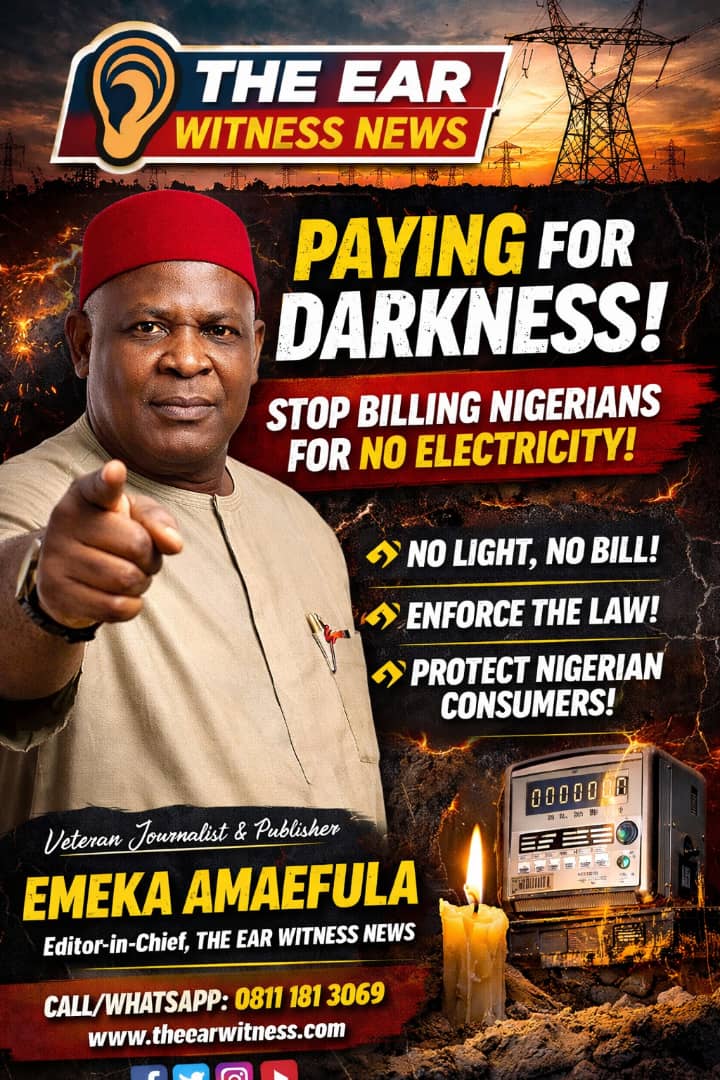
By Emeka Amaefula
Nigeria’s electricity sector privatization, established under the Electric Power Sector Reform Act (EPSRA) 2005, was conceived as a transformative reform to deliver efficiency, reliability, and accountability. Yet, nearly two decades later, millions of Nigerians remain trapped in a system where they are compelled to pay for electricity that is never supplied. Estimated billing—often arbitrary, opaque, and unverified—has become a defining feature of the power sector, raising a troubling legal and moral question: can a service provider lawfully demand payment for services not rendered?
This question gained renewed urgency following the intervention of Adams Oshiomhole on the floor of the Senate, where he drew attention to the injustice faced by ordinary Nigerians who not only pay for electricity but, in many instances, are forced to provide infrastructure such as transformers, cables, and installation, only to remain in darkness. His observation reflects a deeper structural failure—one that appears to invert the logic of privatization by transferring the burden of investment and inefficiency onto the consumer.
The legal framework governing Nigeria’s electricity sector leaves little room for ambiguity. Section 32 of the EPSRA vests the Nigerian Electricity Regulatory Commission (NERC) with the responsibility to ensure efficient, safe, and reliable electricity supply, while also protecting consumer interests and guaranteeing fair and transparent market practices. Section 67 of the same Act empowers NERC to regulate tariffs in a manner that is just, reasonable, and reflective of actual consumption. These provisions, taken together, impose a statutory duty on both the regulator and licensed operators to ensure that billing corresponds to verifiable service delivery. A system that permits billing without supply is therefore not merely inefficient—it is inconsistent with the express intent of the law.
In recognition of these obligations, NERC has issued several regulatory instruments aimed at protecting consumers. The NERC Customer Service Standards of Performance for Distribution Companies Regulations 2007 require distribution companies to maintain minimum service levels and provide clear billing information.
The NERC Methodology for Estimated Billing Regulations 2012 was introduced to curb the excesses of arbitrary billing by setting limits and conditions under which estimation may occur. More significantly, the Meter Asset Provider (MAP) Regulations 2018 were enacted to accelerate the rollout of prepaid meters and eliminate estimated billing altogether. In recent years, NERC has also issued a series of Orders on Capping of Estimated Bills, designed to prevent distribution companies from charging beyond prescribed limits for unmetered customers. Yet, despite these regulatory interventions, the lived reality of Nigerians suggests a persistent gap between law and enforcement.
The insights of Sam Amadi, former Chairman of NERC, further illuminate this contradiction. He consistently argued that the electricity market must operate on cost-reflective tariffs that allow investors to recover costs and earn reasonable returns. However, he also acknowledged that such a framework presupposes a functioning system—one in which electricity is actually delivered to consumers. Without service, the economic and legal justification for billing collapses. Cost recovery without value delivery is not reform; it is distortion.
Nigerian courts, though not always confronted directly with electricity billing disputes, have long established principles that are directly applicable. In Mojekwu v Mojekwu, the court condemned practices that offend equity, justice, and good conscience, while in Anekwe v Nweke, the Supreme Court reaffirmed that no system—customary or otherwise—can stand where it produces injustice.
More directly relevant is the decision in Ikeja Electric Plc v NERC, where the courts upheld the regulatory authority of NERC to impose conditions and protect consumers within the electricity market. These authorities reinforce a simple but powerful proposition: legality cannot be divorced from fairness, and any arrangement that systematically exploits consumers cannot be sustained under the law.
Beyond statutory and judicial considerations lies an even more fundamental question—one of morality. At its simplest, theft involves obtaining value without lawful justification. When electricity distribution companies collect money for power not supplied, how does this differ, in substance, from obtaining value under false pretence? This is not a rhetorical flourish; it is a question that goes to the heart of public trust in both market institutions and the rule of law.
The Nigerian electricity consumer today bears a disproportionate burden. They fund infrastructure, endure erratic or non-existent supply, and still receive inflated or estimated bills. Meanwhile, enforcement remains weak, and sanctions for non-performance are either inadequate or inconsistently applied. Even with ongoing reforms under the Electricity Act 2023, the persistence of these practices suggests that the challenge is not merely legislative but institutional.
If Nigeria is to restore confidence in its power sector, it must move beyond policy declarations to decisive action. The statutory obligations under Sections 32 and 67 of the EPSRA must be strictly enforced. NERC’s regulations, particularly those on metering and billing, must be implemented without compromise. Distribution companies that fail to deliver electricity should not be permitted to profit from that failure. Consumers must be empowered to seek redress, whether through regulatory mechanisms or the courts.
Electricity is not a luxury; it is a necessity that underpins economic productivity, social development, and human dignity. A system that compels citizens to pay for darkness is not only inefficient—it is unjust, unlawful, and unsustainable. Nigeria must therefore confront a stark choice: to continue tolerating a regime where darkness is billed as light, or to uphold the rule of law and protect its citizens from systemic exploitation. In the end, the question remains unavoidable: if payment is demanded for nothing delivered, what, in truth, do we call it?
Author Bio & Contact:
Emeka Amaefula is a veteran journalist, writer, author, poet, Publisher/Editor-in-Chief of The Ear Witness News, Bureau Chief (Rivers State) City People Magazine, Lagos, and a community chief.
WhatsApp: +234(0)8111813069
Email: amaemeka2001@gmail.com
Address: No. 47 Ikwerre Road, Mile One, Port Harcourt City, Rivers State, Nigeria